
Drones · Archive
Privacy Laws for Drone Companies in India: DPDP Act Compliance Guide
India privacy compliance guide for drone companies: DPDP applicability, footage, consent, security, breach reporting, retention and contracts.
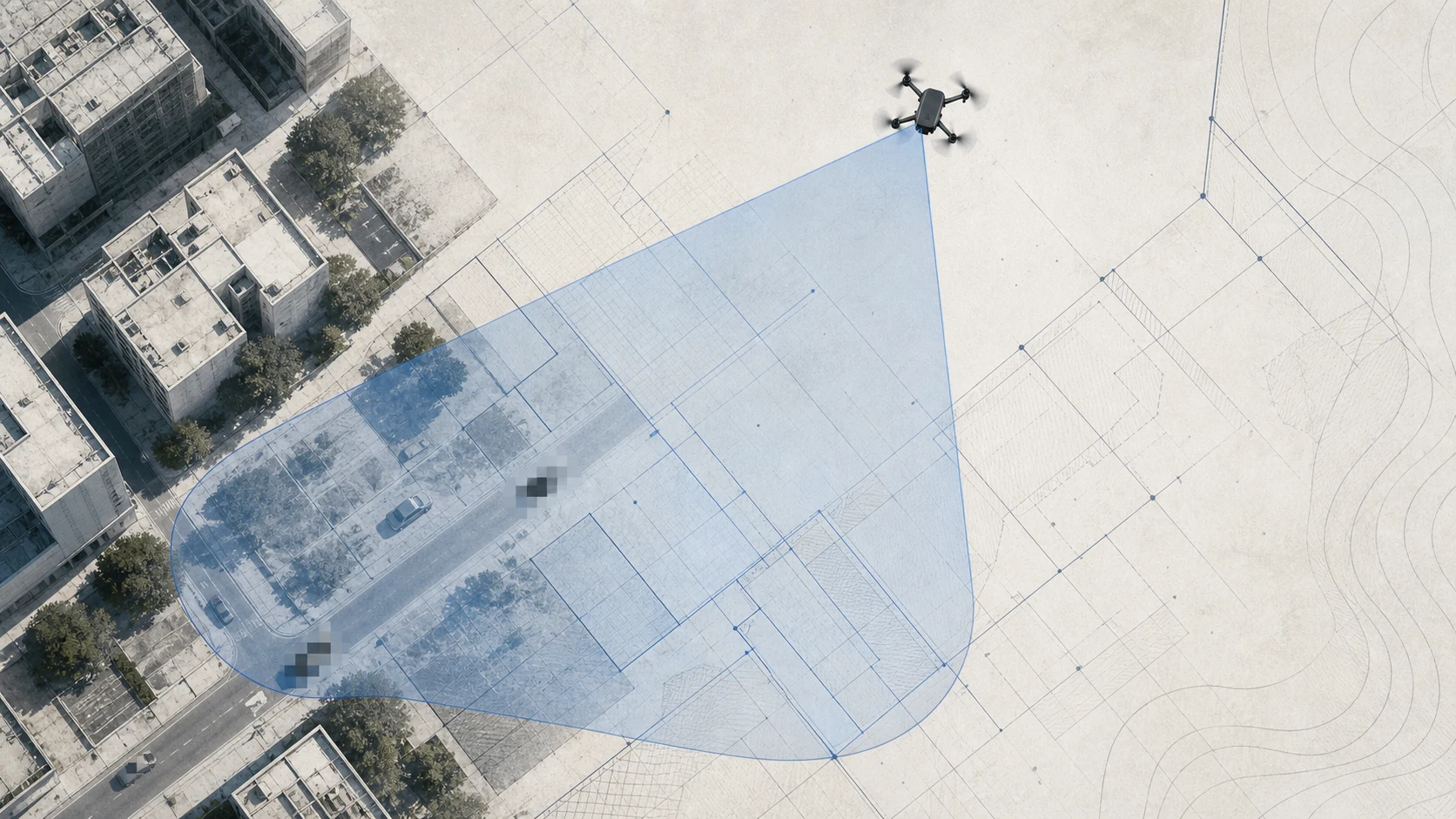
How the DPDP Act, IT Act, SPDI Rules, CERT-In Directions, Drone Rules and geospatial requirements apply to drone operators, drone-as-a-service platforms and analytics providers.
Privacy and data-protection laws can apply when a drone business processes digital data about an identifiable individual. That may include customer details, pilot records, incident reports and identifiable imagery. It does not mean that every photograph, coordinate or flight log is personal data. The answer depends on identifiability, the purpose of processing, the parties' roles and the other data available to them.
India's main future-facing framework is the Digital Personal Data Protection Act, 2023 (DPDP Act) and the Digital Personal Data Protection Rules, 2025. Most operational provisions are scheduled to commence on 13 May 2027. Until then, the Information Technology Act, 2000 and the 2011 SPDI Rules remain in currency. Cybersecurity, aviation, geospatial, criminal, contractual and civil-law issues may apply separately.
Rather than starting with a generic privacy policy, every drone company should first map the data collected in each workflow, identify who decides why and how that data is used, and then assign the legal ground, controls, retention period and incident route for that workflow.
Contents
Key takeaways
Drone footage is personal data only where an individual is identifiable by or in relation to it. A public location does not automatically make the recorded data 'publicly available' under the DPDP Act.
Flight telemetry is often operational data, but it can become personal data when linked to a named or otherwise identifiable pilot, customer, property occupier or incident participant.
The data fiduciary is the person that determines the purpose and means of processing. An operator, enterprise client, platform or analytics provider may occupy that role for different activities in the same service.
Consent is important but is not the only lawful ground under the DPDP Act. Section 7 contains limited 'certain legitimate uses'; it is not a general legitimate-interests test.
Breach reporting follows different timelines. Affected individuals must be informed on awareness in the prescribed manner; the Board receives an initial intimation without delay and further particulars within 72 hours. CERT-In may separately require reporting within six hours for listed cyber incidents.
The Drone Rules regulate aircraft and operations. They do not, by themselves, create a complete privacy code for imagery and analytics.
1. Which privacy laws apply to drone companies in India?
The applicable set of rules depends on the date, the data and the activity. The position changes over time:
Period / layer | What applies | How it impacts a drone business |
Now, as at 4 August 2026 | The DPDP Act's definitions and institutional provisions are in force, but most substantive duties are not yet operative. Section 43A of the IT Act and the SPDI Rules remain relevant where sensitive personal data or information is handled. | Current contracts and security practices should satisfy the present regime while being designed for the scheduled DPDP transition. |
From 13 May 2027 | Sections 3-17 and most operating rules, including notice, security, breach, retention, child-data, rights and transfer provisions, are scheduled to commence. | The core DPDP compliance model will become operational, subject to the Act, Rules and any intervening notification or order. |
Separate, continuing layers | CERT-In Directions, the Drone Rules, geospatial requirements, criminal law, contracts, confidentiality and fact-specific civil claims. | Separate laws govern unlawful flight, prohibited disclosure, cybersecurity failure or misuse of intimate imagery. |
The DPDP Act applies to digital personal data collected in digital form or collected non-digitally and digitised later. It also has an extraterritorial limb where processing outside India is connected with offering goods or services to individuals in India (section 3).
Exclusions: The Act does not apply to personal data processed by an individual for a personal or domestic purpose. It also excludes personal data made publicly available by the individual concerned, or by another person under a legal obligation to make it public. A commercial drone operator cannot rely on the domestic-purpose exclusion. Nor does filming a person in a public place automatically place the resulting footage within the public-availability exclusion.
2. When does drone data become personal data?
The DPDP Act defines personal data as data about an individual who is identifiable by or in relation to that data. Identifiability is contextual. A data point may be non-personal in one system and personal in another because the second system has identifiers, lookup tables or linked records.
Drone-data category | Likely position | Questions to ask |
Customer and delivery data | Names, phone numbers, addresses, account IDs and proof-of-delivery records are ordinarily personal data when they concern an individual. | Is every field necessary? Is the recipient also the purchaser? Who receives the proof of delivery? |
Pilot and remote-pilot records | Names, credentials, contact details, shift assignments and performance records are personal data. Corporate licence documents may contain personal data within them. | Is the pilot an employee or contractor? Is pilot identity necessary for analytics or only for compliance? |
Flight telemetry | Coordinates, altitude, airspeed, battery, signal and mission logs are often operational. They become personal data where linked to an identifiable pilot, customer, occupier or recurring individual pattern. | Can the record be processed/used without pilot or customer identifiers? Does another party hold a mapping key? |
Imagery and sensor feeds | Faces, voices, number plates, distinctive property features or repeat behavioural patterns may make an individual identifiable. Wide-area imagery with no realistic route to identification may not be personal data. | What resolution is retained? Are identifiers blurred at source? Can imagery be joined with address, KYC or incident records? |
Incident and near-miss files | Often mixed: equipment data may be non-personal, while witness, injured-person, pilot and claimant details are personal data. | Can personal narratives be separated from technical evidence? Who needs access to each layer? |
Maintenance and airworthiness records | Usually operational, but named technician, sign-off or disciplinary records may be personal data. | Can technician identifiers be tokenised or held only by the operator? |
Insurance and financial material | A company's policy or invoice is not personal data merely because it is confidential. Sole-proprietor, bank, payment or named contact information may be personal data; some fields may also be SPDI under the current rules. | Is the business an individual proprietorship? Is regulated or financial data included? |
Derived risk scores and analytics | A derived score remains personal data if it relates to an identifiable person, even if the raw data has been transformed. | Does the score affect a pilot, customer or claimant? Can the recipient trace it back to an individual? |
Pseudonymisation is not anonymisation: Masking a pilot name with a token can reduce risk. If the platform or another reasonably connected participant holds the mapping needed to re-identify the person, the data can still be personal data. True anonymisation requires a fact-specific assessment of whether identification is no longer reasonably possible in the relevant context.
3. Who is the data fiduciary: the operator, client or platform?
The label is based on the decision-making power and not the contract heading. A data fiduciary determines the purpose and means of processing. A data processor handles personal data on a fiduciary's behalf. The fiduciary remains responsible for processing carried out on its behalf and may engage a processor for activities related to offering goods or services only under a valid contract (section 8).
Operating model | Likely role analysis | Contract and product consequence |
Enterprise client commissions a survey and determines the site, purpose, outputs and recipients | The client is likely a fiduciary for the commissioned processing. The operator and platform may be processors to the extent they act only on documented instructions. | Instructions, security, deletion/retention, sub-processors, rights assistance and incident escalation should be written into the services contract. |
Operator chooses how to reuse footage for training, benchmarking or its own product improvement | The operator is likely a fiduciary for that independent reuse, even if it was a processor for the original survey. | The reuse needs its own lawful ground, notice analysis, minimisation and retention rule. Client permission alone may not resolve the rights of individuals in the data. |
Self-service analytics platform scores client-uploaded records using fixed functions | The platform may be a processor if the customer determines the relevant purpose and means and the platform does not use the data independently. | Avoid unnecessary ingestion; separate service data from the platform's own account, security and billing data. |
Managed service selects data sources, enriches records, decides scoring logic or shares outputs for its own commercial purpose | Those decisions can make the provider a fiduciary for some processing. Role allocation may differ across ingestion, analysis, support, security and sharing. | Prepare an activity-level responsibility matrix rather than calling one party a processor for the entire relationship. |
A processor ordinarily should not seek duplicate consent for processing carried out solely on the fiduciary's instructions. The fiduciary must establish the ground and be able to demonstrate compliant notice and consent where consent is used. The processor needs a separate analysis for its own account administration, fraud prevention, product analytics, model training or other independent purpose.
4. Do drone companies always need consent?
No. Under section 4, processing must be for a lawful purpose and based on either consent or one of the 'certain legitimate uses' in section 7. Consent must be free, specific, informed, unconditional and unambiguous, signified by clear affirmative action, and limited to personal data necessary for the specified purpose. Withdrawal must be as easy as giving consent.
Section 7 is narrower than the broad legitimate-interests tests found in some foreign laws. Relevant possibilities include data voluntarily provided by an individual for a specified purpose, certain legal disclosures and orders, emergencies, disaster response and specified employment-related processing. A company should record the exact clause relied on; 'business necessity' or 'legitimate interest' is not enough by itself.
Incidental bystanders
A bystander captured incidentally has not necessarily volunteered personal data or consented. The difficulty of obtaining consent from everyone in a camera's field of view is not a statutory exemption. Mission design should therefore limit unnecessary identifiability: restrict the field of view, altitude and resolution; use no-capture or no-retention zones; blur faces and plates as early as possible; retain only selected frames; and tightly limit access and reuse. The relevant fiduciary must still identify a lawful ground for any personal data it processes.
Employees and contractor pilots
Section 7(i) permits processing for employment purposes and specified employer-protection purposes. It should not be treated as a blanket ground for all workplace monitoring. It may apply to employed pilots where the processing fits the provision. An independent-contractor pilot is not an employee merely because the operator controls a mission; another valid ground will ordinarily be required.
Children
A child is an individual under 18. Unless an exemption applies, section 9 requires verifiable parental consent before processing a child's personal data and restricts detrimental processing, tracking or behavioural monitoring of children, and targeted advertising directed at children. Operations near schools, playgrounds and events therefore need a deliberately conservative capture and retention design. The presence of children does not automatically make the flight unlawful, but identifiable child data can materially change the compliance analysis.
5. What should privacy-by-design look like in a drone workflow?
The most effective privacy control is to avoid collecting or retaining data that the service does not need. This is particularly important for platforms that score or analyse drone records: the model may need flight performance but not a pilot's name, a delivery recipient's phone number or full-resolution imagery.
Before the flight: define the mission purpose, data fields, field of view, resolution, retention and recipients. Identify sensitive locations, expected bystanders and whether children are likely to be captured.
At capture: prefer edge filtering, geofenced camera restrictions, event-triggered recording and immediate blurring or cropping where technically and operationally feasible.
At ingestion: separate operational telemetry from identifiers; reject unnecessary columns and attachments; quarantine incident narratives and identity records from routine analytics.
During processing: use least-privilege access, tenant separation, encryption, monitoring, reviewable logs and tested backups. Keep the re-identification key with the operator where the platform does not need it.
At output: disclose only the score, segment or evidence necessary for the recipient's purpose. Do not expose raw footage or identity fields merely because the system has them.
At deletion: distinguish active-use cessation from legally required restricted retention. Deletion requests must flow to processors and sub-processors, subject to applicable retention duties.
If a score or report will be used to make a decision affecting an individual, or will be disclosed to another fiduciary, section 8(3) requires the fiduciary to ensure completeness, accuracy and consistency. That can be relevant where analytics affects a pilot's work allocation, an individual's insurance claim or another consequential decision.
6. Notices, rights and grievance handling
Once the relevant DPDP provisions commence, a consent request must be accompanied or preceded by notice. The notice must identify the personal data and specified purpose and explain how the individual can exercise rights and complain to the Board. Rule 3 requires an independently understandable, itemised description of the personal data and the specified purpose, together with the goods, services or uses enabled by the processing.
Individuals have statutory rights of access, correction, completion, updating, erasure, grievance redressal and nomination, subject to the Act. Rule 14 requires the fiduciary to publish the means for exercising rights and a grievance-response period that does not exceed 90 days. A processor should have a shorter contractual service level so the fiduciary can investigate, locate data and respond within its published period.
Rights compliance is not confined to a customer database. A drone business should be able to find relevant personal data across flight records, still images, video, incident files, support tickets, exports, backups and derived reports. It should also record where erasure cannot yet occur because a law requires continued retention.
7. Security, retention and breach reporting
Security
Rule 6 sets minimum components of reasonable security safeguards, including appropriate encryption, obfuscation, masking or tokenisation; access controls; logs, monitoring and review; continuity measures such as backups; security provisions in processor contracts; and appropriate technical and organisational measures. Implementation will depend on the data and the risk. A policy on its own will not meet these requirements.
Retention
The DPDP Act generally requires erasure when consent is withdrawn or it is reasonable to assume that the specified purpose is no longer served, unless another law requires retention. The Rules add specific retention duties. Rule 6 requires relevant logs and personal data to be retained for one year for detection, investigation, remediation and continuity, unless another law requires otherwise. Rule 8(3), once operative, requires the fiduciary to retain specified personal data, associated traffic data and processing logs for at least one year from processing for the purposes in the Seventh Schedule, and then cause erasure unless further retention is legally required or notified.
Avoid promises of immediate deletion: A privacy notice or contract should not promise that every copy will be deleted immediately on request. It should distinguish cessation of ordinary use, deletion from active systems, restricted legal/security retention, backup cycles and downstream processor deletion.
Breach and cyber-incident clocks
Recipient / route | Timing | What the rule requires |
Affected Data Principal under DPDP Rule 7 | On becoming aware of the personal data breach | A concise and clear intimation containing the prescribed information, including the nature and consequences, mitigation, safety measures and a contact point. |
Data Protection Board - initial intimation | Without delay | Description of the nature, extent, timing, location and likely impact of the breach. |
Data Protection Board - further particulars | Within 72 hours of awareness, unless the Board allows more time | Updated findings, circumstances and causes, mitigation, prevention, reports to other authorities and the report of notices sent to affected individuals. |
CERT-In for listed cyber incidents | Within six hours of noticing the incident or being informed of it | Separate report by covered entities under the 2022 Directions. Listed incidents include data breaches and certain attacks on systems, IoT devices and drones. |
Processor to fiduciary | Contractual - set in hours, not days | The DPDP statute places the external notification duty on the fiduciary. The contract should require escalation early enough for the fiduciary to meet every applicable deadline. |
A single incident may trigger more than one route. The incident plan should therefore classify the event, preserve evidence, contain harm, identify affected people, coordinate communications and run DPDP, CERT-In, contractual and sectoral assessments in parallel.
8. Cloud hosting, overseas access and geospatial data
Cross-border personal-data transfers
The DPDP Act does not impose a blanket localisation rule for all personal data. Section 16 permits the Central Government to restrict transfers to notified countries or territories, and Rule 15 permits transfers subject to requirements the Government may specify concerning availability of data to a foreign State or entities under its control. More restrictive requirements in other Indian laws remain relevant.
Geospatial data
Drone surveys, photogrammetry and mapping can also engage the 2021 Geospatial Guidelines. The Guidelines generally removed prior-approval, security-clearance and licensing requirements for geospatial data, subject to their conditions and a self-certification model. They do not grant a right of physical or aerial access to restricted premises.
The Guidelines prescribe threshold values, including one metre for horizontal positional accuracy and three metres for vertical positional accuracy. Geospatial data and maps finer than the threshold values may be created or owned only by Indian entities and must be stored and processed in India; foreign companies may license such data from Indian entities through APIs subject to the Guidelines. A drone company should analyse the accuracy, ownership, storage, processing and customer-access model rather than assuming that the DPDP transfer rule answers the geospatial question.
9. What should drone-data contracts cover?
The services agreement, data-processing terms and product architecture should tell the same story. Calling a platform a processor will not protect it if its actual product makes independent decisions about use or disclosure.
Activity-specific roles: who is fiduciary or processor for capture, upload, analytics, support, security, benchmarking and disclosure.
Documented instructions and permitted purposes, including a clear prohibition on unrelated model training or commercial reuse unless separately authorised and lawfully grounded.
A data schedule that distinguishes operational, personal, sensitive, confidential, regulated and geospatial data rather than treating every upload alike.
Minimum security controls, audit evidence, personnel access, tenant separation, encryption, logs, backups and vulnerability handling.
Processor incident notification measured in hours, with the information and cooperation needed for DPDP, CERT-In, customer and sectoral reporting.
Sub-processor approval, location, equivalent obligations and flow-down of deletion, rights and incident duties.
Retention by data class, legal holds, security logs, active-system deletion, backup treatment and verified exit deletion.
Rights assistance, searchable identifiers, correction of source and derived records, and a service level shorter than the fiduciary's public response period.
Accuracy, provenance and challenge mechanisms where outputs affect people or are shared with another fiduciary.
Ownership and licence terms for raw data, derived outputs and models. DPDP regulates personal-data processing; it does not itself grant a property right in all data.
10. What issues arise beyond the DPDP Act?
Issue | Why it matters |
Drone Rules and airspace | Registration, certification, remote-pilot, airspace-zone and operating requirements are separate from privacy compliance. A lawful data-processing ground does not authorise an unlawful flight. |
CERT-In cybersecurity | Covered entities must maintain ICT logs for 180 days within India, designate a point of contact and report listed incidents within six hours. The retention purpose and dataset differ from DPDP Rule 8(3). |
Intimate or voyeuristic capture | Section 66E of the IT Act is a narrow offence concerning intentional or knowing capture, publication or transmission of an image of a person's statutorily defined private area without consent in privacy-violating circumstances. Sections 77 and 78 of the Bharatiya Nyaya Sanhita address voyeurism and stalking on their own elements. These are fact-specific criminal provisions, not a general ban on public photography. |
Restricted premises and sensitive sites | Geospatial liberalisation does not confer access rights. Defence, critical infrastructure, government, industrial and private sites may have separate security, access, confidentiality or contractual restrictions. |
Confidentiality, trade secrets and contracts | Drone records can expose layouts, inventory, routes, infrastructure condition and business operations even when no person is identifiable. Contractual confidentiality and information-security controls may be the principal protection. |
Trespass, nuisance and civil claims | Indian law does not yet offer a simple, drone-specific answer for every aerial intrusion. Low or repeated flights, interference, surveillance and loss may engage property, nuisance, negligence, contract or other civil principles depending on the facts. |
Sector-specific regulation | Healthcare, insurance, financial services, telecom, government, defence, agriculture and critical-infrastructure work may carry additional secrecy, security, recordkeeping, procurement or vendor obligations. |
Evidence and investigations | If footage, telemetry or logs may be used in an accident inquiry, claim or court proceeding, preserve provenance, timestamps, access history and integrity. Routine deletion should be suspendable under a documented legal hold. |
Constitutional privacy | The Supreme Court has recognised privacy as a fundamental right. Constitutional review is most direct in relation to State action. Private-sector disputes still require careful analysis of applicable statutes, contracts and civil or criminal law. |
11. A practical compliance roadmap for drone companies
Build a data inventory by workflow, not only by database. Include the flight, controller, edge device, upload path, cloud, analytics layer, exports, support systems and backups.
Classify each field and file: personal or non-personal, operational, confidential, geospatial, regulated, security-relevant and evidentiary.
Map the purpose and means for each processing activity and assign fiduciary/processor responsibility. Revisit the analysis when moving from self-service software to managed services.
Record the exact lawful ground. Where consent is used, prepare an itemised notice and a demonstrable consent and withdrawal flow. Do not use a generic 'legitimate interest' label.
Remove identifiers that are not needed. Keep re-identification mappings away from analytics platforms where possible and prevent raw-data ingestion that the product does not use.
Implement the Rule 6 security baseline and test it against drone-specific risks such as lost aircraft, removable media, insecure radio links, compromised operator accounts and exposed imagery links.
Create a retention schedule that reconciles mission needs, DPDP Rules, CERT-In logs, aviation and sectoral requirements, claims periods, legal holds and backup deletion.
Run a breach exercise that starts with a processor alert and tests the six-hour CERT-In route, DPDP initial and follow-up reports, affected-person notices and customer communications.
Make rights requests technically executable across raw, redacted, derived and exported records. Correct downstream scores where source data was inaccurate.
Review cloud regions, overseas support access and geospatial thresholds separately. DPDP transfer permission does not displace stricter geospatial or sectoral localisation.
Update customer and vendor contracts to match the role map and operational controls. Obtain evidence, not merely warranties, for high-risk processors.
Schedule a legal and technical readiness review before 13 May 2027, with an earlier trigger for amendments, orders, new processing purposes or material product changes.
Frequently asked questions
Does the DPDP Act apply to drone companies in India?
It can. The core test is whether the company processes digital personal data: data about an identifiable individual. Most substantive DPDP obligations are scheduled to commence on 13 May 2027. Current IT Act, SPDI, cybersecurity and other laws may apply before and after that date.
Is drone footage always personal data?
No. Footage is personal data where an individual is identifiable by or in relation to it. Resolution, angle, linked records, repeated observation and the recipient's ability to identify a person all matter.
Is a vehicle number plate or house number automatically personal data?
Not automatically. It becomes personal data where it relates, directly or through available links, to an identifiable individual. The same identifier may be personal in one party's hands and non-personal in another's.
Does filming in a public place mean the data is publicly available?
No. The DPDP exclusion concerns data made publicly available by the individual, or by another person under a legal duty to publish it. A drone recording made in a public place does not qualify merely because the person was visible there.
Must a drone operator obtain consent from every bystander?
The law does not create a general bystander-consent exemption, but consent is not the only possible ground. The responsible fiduciary must identify a valid ground for the processing. In practice, missions should minimise incidental identification and avoid retaining unnecessary bystander data.
Is flight telemetry personal data?
Often it is operational data. It becomes personal data where it is linked to an identifiable pilot, customer, property occupier or other individual, including through a mapping key or combined dataset.
Who is the data fiduciary in a drone-as-a-service model?
The person that actually determines the purpose and means of the processing. That may be the enterprise client for a commissioned survey, the operator for its own reuse, or a platform for processing it independently determines. Roles can differ by activity.
Can a platform rely on the operator's consent?
A platform acting only as processor ordinarily operates on the fiduciary's documented instructions and should not obtain duplicate consent for that processing. Its own independent uses need a separate role and lawful-ground analysis.
Must all drone data be stored in India?
No single rule creates blanket localisation for all drone data. DPDP permits overseas transfers subject to government requirements. CERT-In imposes Indian retention for specified ICT logs, and fine geospatial data is subject to separate Indian-entity and India storage/processing conditions.
What is the data-breach reporting deadline?
There is no single universal 72-hour rule. Under the notified DPDP Rules, the Board receives an initial intimation without delay and further particulars within 72 hours; affected individuals are notified on awareness in the prescribed manner. CERT-In may separately require a listed cyber incident to be reported within six hours.
Do the Drone Rules, 2021 contain a complete privacy regime?
No. They regulate drones and their operation, including airspace and operational requirements. Privacy and data use must be analysed under the DPDP framework, IT Act, cybersecurity rules, criminal law, contracts and other applicable law.
What are the DPDP penalties relevant to drone businesses?
The statutory schedule permits penalties up to ₹250 crore for failure to take reasonable security safeguards, up to ₹200 crore for breach-notification and children's-data failures, and up to ₹50 crore for certain other breaches. Actual penalty depends on the Board's process and statutory factors.
Conclusion
For drone companies, privacy compliance is an engineering and contracting question before it is a policy exercise. In practice, the work begins with separating operational data from personal data, limiting avoidable identification and allocating responsibility for each processing activity. Rights handling and incident response then need to be built into the service, with DPDP, cybersecurity, aviation and geospatial requirements addressed as distinct but coordinated workstreams.
Most DPDP operating provisions are scheduled to commence on 13 May 2027. Drone businesses should use the intervening period to test their ingestion rules, role allocation, contracts, retention schedules and breach procedures. Updating a website privacy notice shortly before commencement will not cure weaknesses in those underlying systems.
Primary sources
1. Digital Personal Data Protection Act, 2023 - official MeitY text
2. DPDP Act commencement notification dated 13 November 2025 - official Gazette notification
3. Digital Personal Data Protection Rules, 2025 - official Gazette text
4. MeitY DPDP Rules page and corrigendum - official source page
5. Information Technology Act, 2000 - India Code text, including sections 43A, 66E and 72A
6. Information Technology (Reasonable Security Practices and Procedures and Sensitive Personal Data or Information) Rules, 2011 - official rules
7. CERT-In Directions dated 28 April 2022 - official cybersecurity directions
8. Drone Rules, 2021 - Ministry of Civil Aviation source page
9. Guidelines for Acquiring and Producing Geospatial Data and Geospatial Data Services, 2021 - Department of Science and Technology
10. Bharatiya Nyaya Sanhita, 2023 - India Code text, including sections 77 and 78
Earlier article: Understanding the Data Protection Law's Impact on Drone Operations
Publication credits
Authors

Abhinav Goyal
Partner