Drones · Archive
Import & Export Regulations for Drones in India
Guide to India’s drone import restrictions, component imports, DGFT licensing, civilian exports, SCOMET controls and Ministry of Defence clearance.
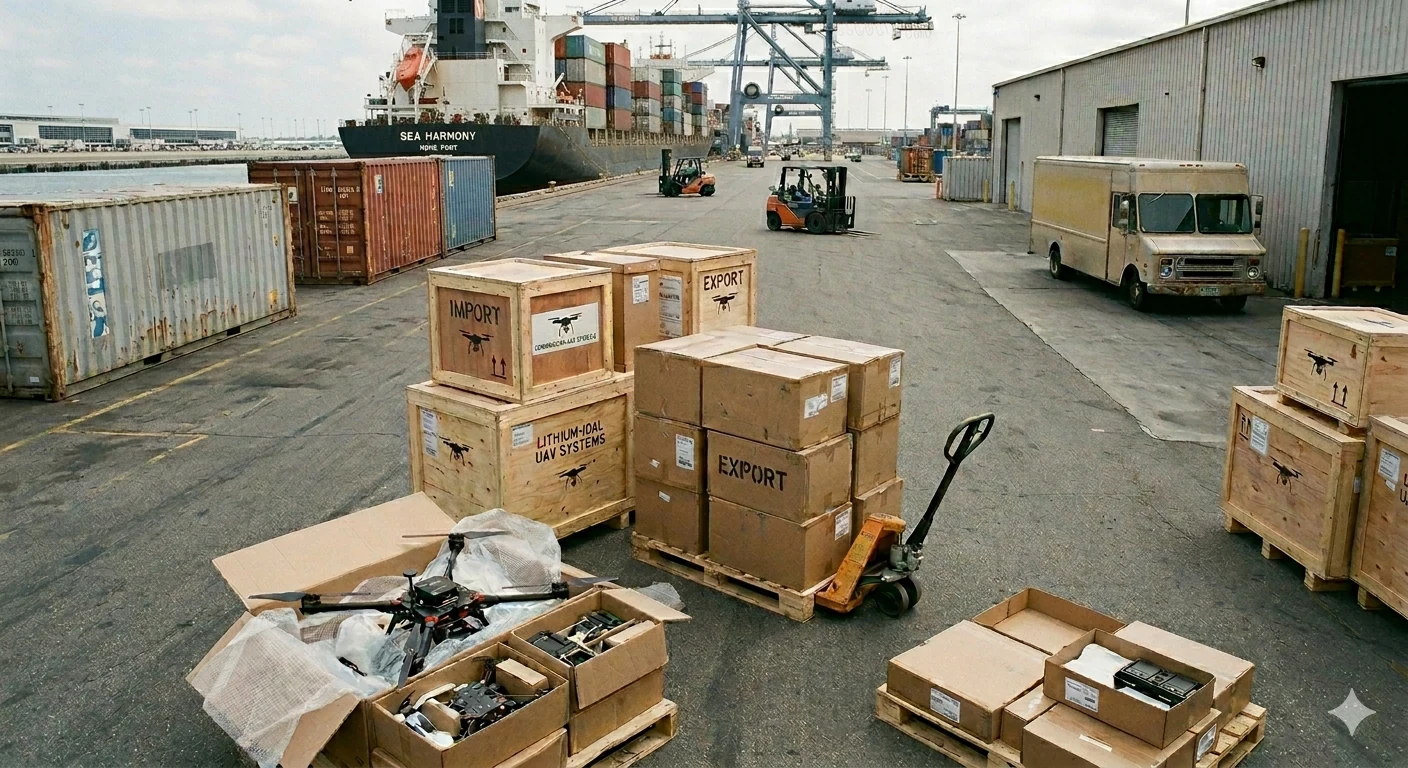
India is positioning itself to become a global drone hub by 2030, backed by government initiatives directed at increasing domestic manufacturing. These include a proposed ₹2,000 crore incentive programme aimed at localizing production of at least 40% of drone components by FY 2027-28, and a uniform 5% GST rate on all drones effective September 9, 2025.
For importers and exporters operating in or seeking to enter this industry, it is crucial to understand India's regulatory framework. The trade policy is administered through the Directorate General of Foreign Trade (‘DGFT’) and the framework on licensing and operations through the Directorate General of Civil Aviation (‘DGCA’). Under this structure, India restricts imports while ensuring easy export of drones, with an aim to grow domestic manufacturing and help Indian products compete in global markets.
This article provides a guide to India's drone import and export regulations, covering both civilian and defense/military applications. The article is meant for drone manufacturers and component suppliers entering the Indian market, manufacturers planning to export, defense contractors developing military drones, legal and compliance teams managing and working through regulatory requirements and foreign companies considering partnerships with Indian drone entities.
Imports
India’s drone import framework discourages the import of fully built foreign drones or easy-to-assemble ones. The DGFT's February 9, 2022 notification (‘Notification’) blocks imports of complete or easily assembled drones, but allows import of drone components creating a system of protection for the domestic manufacturing market.
DGFT’s February 2022 Import Ban
The Notification changed India’s import policy for drones. The notification prohibited imports of drones in Completely Built-Up (CBU), Completely Knocked-Down (CKD) and Semi-Knocked-Down (SKD) forms with immediate effect. Therefore, import of all ready-to-fly or easily assembled foreign drones for general civil use came to be prohibited.
Exceptions
The notification provides exceptions,, subject to import authorisation issued by DGFT in consultation with concerned line ministries:
Research & Development: Government entities, educational institutions recognized by central or state governments, government-recognized R&D entities and domestic drone manufacturers may import complete drones.
Defense & Security: Imports of military or defence-grade drones are permitted only for defence, security or strategic purposes, typically by Government entities or under Government-approved procurement systems and are subject to prior approval of the DGFT, including the concerned ministry.
Component Imports: Drone components, for example, motors, cameras, flight controllers, batteries, propellers, sensors and frames face no import restrictions and remain classified as 'Free' for import. This allows Indian manufacturers to source global components while performing final assembly domestically, supporting the government's phased indigenization strategy. This exemption aligns with Atmanirbhar Bharat (self-reliant India) strategy as it protects domestic manufacturers from foreign competition, particularly Chinese giants like DJI and enables technology transfer & local assembly. Additionally, components or parts of drones intended for import require advance approval from DGCA under Form UA-8.
Post-Import Compliances
Clearing DGFT import prohibition is a necessary but not the only condition for a drone to be lawfully operated or sold in India. There are two further regulatory layers that are applicable:
Type Certification: Type Certification under Rule 8 of the Drone Rules, 2021 from DGCA. The Civil Drone (Promotion and Regulation) Bill, 2025, if enacted, may extend Type certificate requirements to manufacturing, assembling, sale and transfer.
Radio-frequency: Drones carrying RF modules require Equipment Type Approval (ETA) from the Wireless Planning and Coordination Wing (WPC) of the Department of Telecommunications.
Enforcement Reality & Grey Market
Despite the prohibition, imported drones remain widely used in India, often brought in by travelers or imported privately through grey market channels. Multiple retailers continue advertising foreign drones such as that of Da-Jiang Innovations Sciences and Technologies Limited (‘DJI’) openly through pre-ban inventory or grey imports.
That the Digital Sky Platform (replaced by the eGCA platform in 2025) allowed UIN (Unique Identification Number) registration for foreign drones imported before the 2022 ban, provided owners supplied correct serial numbers, did not help. However, on August 12, 2025, DGCA issued a Public Notice initiating cancellation proceedings for illegally registered drones. The notice targeted entities misusing self-generated UINs for drones manufactured outside India and imported without prior DGFT authorization in violation of DGFT Notification. DGCA identified two primary violations:
Incorrect classification under ‘Model RPAS’ sub-category when drones were not intended solely for educational, research, design, testing or recreational purposes;
Import without authorization of drones in CBU/SKD/CKD form, constituting regulatory breach.
The enforcement action requires affected registrants to submit written explanations with supporting documentation including purchase invoices, DGFT import permissions, NABL-accredited weighing certificates and manufacturer data plate photographs within one month or face cancellation without further notice. Operating drones with suspended/cancelled registrations carries penal action under Drone Rules 2021.
In November 2025, the Central Industrial Security Force (‘CISF’) intercepted 22 high-end DJI Mini 5 Pro drones valued at ₹26.7 lakh at Hyderabad's Rajiv Gandhi International Airport, suspected to be illegally imported from Singapore. There was another seizure later that month, where customs officials impounded 8 advanced drones (among other electronic goods) worth ₹3 crore arriving from Abu Dhabi.
Supply Chain Integrity
There is growing concern over the origin of electronic components used in domestically assembled defence drones. News reports show that Chinese-origin components are mis-labelled as originating from Vietnam, Philippines, Indonesia or other such countries, making it difficult to verify the actual origin. This poses security risks including hidden backdoors, malicious code and unauthorised data links.
In response, the Army Design Bureau (‘ADB’) released a framework for stakeholder consultation which concluded on April 8, 2026, for further incorporation in the Defence Acquisition Procedure, 2026 (‘DAP’) as per various news reports. The framework acknowledges that foolproof supply chain traceability is not feasible, citing trade malpractices, re-routing, falsified documentation and branding as responsible factors. The framework prescribes testing and certification of critical electronic components by government-approved agencies and NABL-accredited laboratories. Vendors found to have fabricated, falsified or misrepresented documents in relation to these components are liable for suspension and debarment. The provisions remain subject to revision prior to incorporation into the final DAP 2026.
Export
The exports policy follows a dual approach of allowing easy export of civil-use drones while imposing stricter rules for military or dual-use drones. The GAED framework allows civilian drones to be exported under a single, one-time authorization, reducing repeated licensing requirements. For systems that fall under SCOMET‑based defence or dual‑use categories, the same framework continues to require individual‑case‑by‑case licensing, inter‑ministerial review and MoD‑guided defence‑export conditions.
Export Control: Two-Tier Licensing System
TIER 1: GAED (General Authorization for Export of Drones) - One-Time License: On June 23, 2023, the DGFT issued a Public Notice liberalizing drone exports by introducing the GAED for which individual SCOMET licences will not be required for each product being exported. The following category of drones requires one time license under GAED:
Drones under SCOMET category 5B(a)(ii): Civilian drones which are not designed for weapon delivery with range ≤25 km, payload ≤25 kg, intended solely for civilian end-use (e.g. agriculture, photography, surveying), not for encrypted communications or advanced military surveillance.
It remains valid for 3 years and requires an end-user certificate and technical specification declaration.
TIER 2: Individual Case-by-Case SCOMET Authorization Required: SCOMET (Special Chemicals, Organisms, Materials, Equipment and Technologies) is India's export control list of dual-use items such as goods, software and technologies with both civilian and military applications, that require government licenses for export.
Appendix 3 (SCOMET items) to Schedule 2 of the ITC (HS) Classification of Export and Import Items, 2018 require individual export licenses for the following:
5B(a)(i): Complete unmanned aerial vehicle systems (including cruise missile systems, target drones, exclusive delivery drones, drones with encrypted/satellite communication, drones with explosive/warhead/electronic warfare payload capability) or any related technology or software.
5B(b): Complete unmanned aerial vehicle systems having an autonomous flight control and navigation capability or capability of controlled flight out of the direct vision range involving a human operator, designed or modified to incorporate an aerosol dispensing system/mechanism, with a capacity greater than 20 liters.
6A010: UAVs lighter than air vehicles, its equipment or components specially designed for military use.
8A912: UAVs designed for controlled flight beyond direct natural vision of the operator, having either (1) endurance ≥30 minutes with capability to fly in wind gusts ≥46.3 km/h (25 knots), or (2) endurance ≥1 hour; equipment to convert manned aircraft to UAVs and engines for high-altitude UAV operations above 15,240 meters.
A civilian drone qualifying for GAED under 5B(a)(ii) requires individual SCOMET license if it possesses encrypted communications (5B(b)), advanced surveillance capabilities (8A912), electronic warfare payloads (6A010), weapon delivery modifications (5B(a)(i)) or exceeds 25 km range/25 kg payload limits.
Application Process for Drone Export Authorization
Below is the application process for both pathways:
GAED: Exporters can submit applications through DGFT's SCOMET online portal using ANF-10G proforma, which inter alia requires following information / documents:
Technical Specifications: Drone model, range, payload capacity, flight endurance, control systems and sensor capabilities.
List of Export Destination Countries: All countries where exports are anticipated during the 3-year validity period. GAED is not issued in respect of countries or entities covered by a UNSC embargo or sanction list or where DGFT determines proliferation concerns or national security and policy considerations.
End-User Certificates (EUC): Certificates in prescribed format [Appendix 10J(i)] from all entities in the supply chain - foreign buyer, consignee, end-user, and intermediaries - on company letterhead, signed in ink and stamped by authorized signatories. EUCs must specify:
Intended use for civilian purposes only
Quantity of drones to be exported
Confirmation that items will not be diverted, modified, or used for military applications
Undertakings on Company Letterhead:
Permission for on-site inspection by DGFT or Government of India representatives
Declaration that drones will not be used for designing, developing or delivering WMD or missile systems
Commitment to notify DGFT immediately if aware of potential military end-use or WMD diversion risk
Agreement to maintain 5-year records of all export documentation
Purchase Orders/Contracts:Agreements or excerpts from contracts with foreign entities stating permitted civilian end-use.
SCOMET: Exporters must apply for authorization using ANF-2 O application format in accordance with the SCOMET guidelines, submitting not limited to the following:
Technical specifications: Complete system capabilities, autonomy levels, range, payload capacity, surveillance features, encryption systems, combat potential.
End-User Certificate (EUC): Mandatory certification identifying foreign buyer, destination country, and intended purpose.
Buyer verification: Foreign entity credentials and government authorization.
MoD Standard Operating Procedure (SOP) for Defence Exports
Military drone exports require Ministry of Defense (MoD) clearance under the SOP for Defence Exports distinct from civilian drone licensing. The SOP applies to armed UAVs, defense-specific components, software, technical know-how and dual-use systems regardless of civilian classification.
Approval Conditions: MoD clearances carry strict binding conditions:
Export limited to specific buyer, quantity, and validity period.
Absolute prohibition on re-export or technology transfer without prior MoD authorization.
Any other condition as specified from time to time.
In order to enhance the credibility of Indian Defence products in global markets and instil confidence amongst foreign buyers, the draft DAP proposes for the issue of the following certificates to Indian vendors. DGQA is the authorised to issue these certificates in accordance with the SOP.
Certificate for ‘Fit for Indian Military Use’: Issued when a product clears technical trials under DAP, iDEX, TDF, Make or Defence Design and Development programmes.
Certificate for ‘Fit as per Vendor Certification’: Issued when a product is tested against vendor-provided specifications, including during development or export preparation.
Certificate of Field Trial Outcome: Issued after Armed Forces field trials, with approval from the competent authority or DGQA, depending on QA involvement.
As the draft DAP consultation process concluded in March 2026 and the final DAP is reported to be near finalisation, the provisions mentioned herein may be revised or modified prior to formal adoption and enforcement of the final framework.
Looking ahead
India's drone import and export regulations establish a framework empowering the domestic manufacturing market. The government has created a protected market for local assembly and production while opening global export pathways for Indian manufacturers.
For Importers: Component imports remain free, but complete drones face stringent restrictions except for R&D and defense purposes. Enforcement is active, with regular seizures at airports and customs checkpoints.
For Exporters: Civilian drones benefit from GAED framework, while military drones face multi-layered SCOMET and MoD clearances. Government-funded technologies (iDEX) carry presumptive export prohibitions.
For Manufacturers: The regulatory structure incentivizes local assembly using imported components, with clear pathways to international markets once domestic production is established. Defense contractors must navigate complex approval processes but gain access to strategic partnerships through frameworks like iDEX.
The regime seeks to balance national security concerns, domestic industrial development and export competitiveness creating both opportunities and compliance complexities for drone industry stakeholders.
__________________________________________________________________________________
Disclaimer: This publication is intended solely for informational and educational purposes. It summarizes recent legal and policy developments from publicly available sources and does not constitute legal advice, opinion or endorsement by Sigma Chambers. All Sources are hyperlinked.
__________________________________________________________________________________
Authors: Abhinav Goyal, Saumya Asthana & Nishika Godha
Readers can direct their queries or comments to the authors.
__________________________________________________________________________________
Publication credits
Authors

Abhinav Goyal

Saumya Asthana